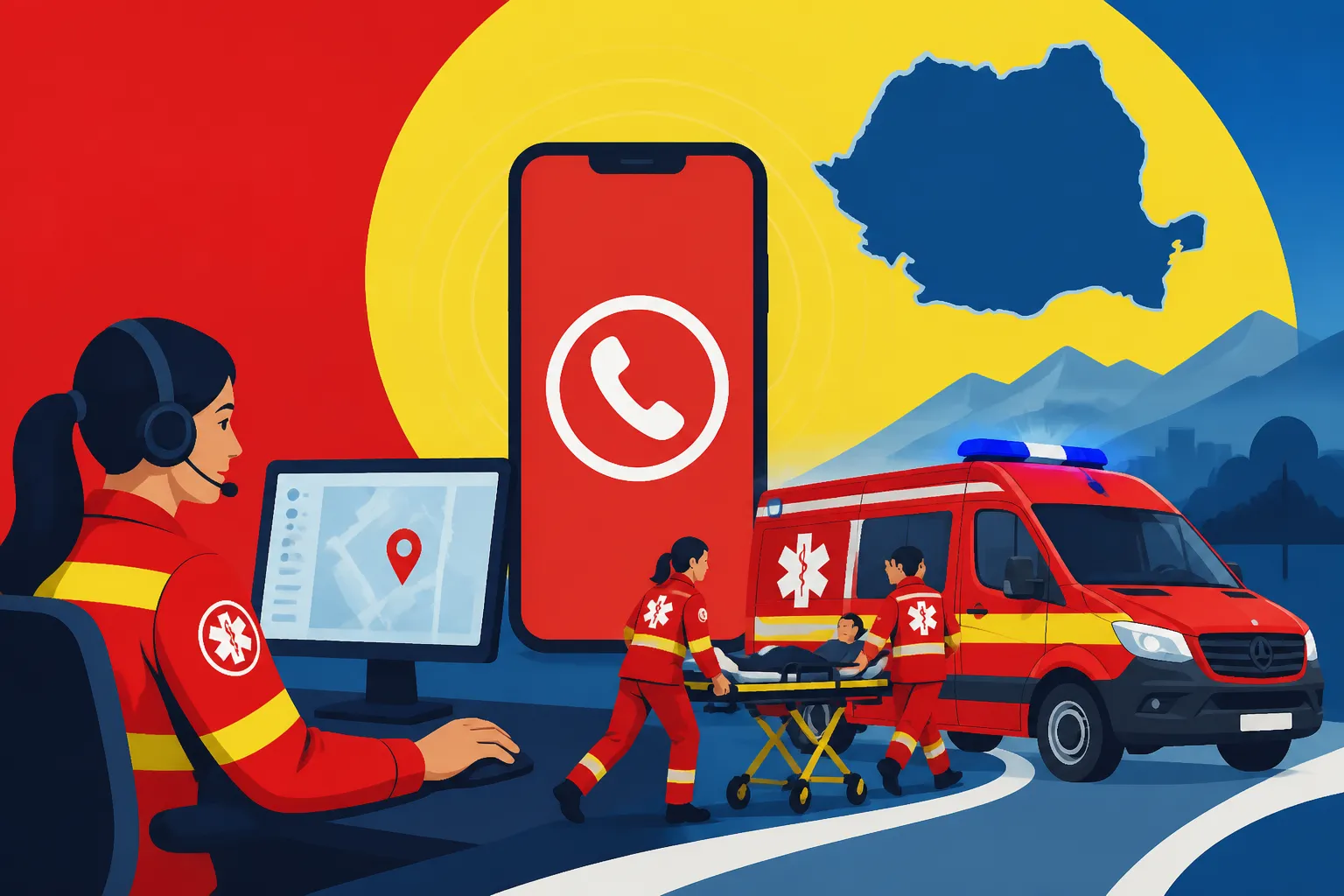
Understanding Emergency Numbers (112) and the SMURD Service in Romania
One of the most terrifying experiences you can face as an expat is a medical emergency in a country where you don't fully speak the language or understand the infrastructure. This guide demystifies the Romanian emergency response system, explaining exactly how to use the 112 number and what to expect when the red SMURD teams arrive at your door.
The Anatomy of 112: How the Romanian Emergency Service Operates
The 112 emergency number in Romania is a centralized system managed by the Special Telecommunications Service (STS). It functions as a unified gateway for all critical services, including the police, the fire department, the gendarmerie, and medical rescue. When you dial 112, you are not calling a hospital directly; you are calling a dispatch center that must filter and redirect your request based on the severity and nature of the situation.
What Happens When You Dial 112?
The moment the call connects, a dispatcher will answer with "112, care este urgența dumneavoastră?" (112, what is your emergency?). In these initial seconds, the system is already attempting to triangulate your location. However, mobile triangulation in Romania is not always pinpoint accurate, especially in older apartment blocks or dense urban areas. The dispatcher will ask for your location, the nature of the emergency, and your phone number.
I have found that staying calm is the hardest part, especially since the dispatchers are trained to be extremely direct and brief. They are following a strict protocol to shave seconds off the response time. They will decide whether to send the regular ambulance service (SAJ) or the specialized SMURD units. It is vital to stay on the line until they tell you to hang up, as they may need to provide life-saving instructions over the phone while the crew is en route. For more context on how this fits into the broader medical landscape, see Navigating the Romanian Healthcare System: An Expat's Roadmap (2027).
Language Barriers and Communicating in English
While 112 dispatchers are technically required to have English proficiency, the reality on the ground can be hit-or-miss. In major hubs like Bucharest, Cluj-Napoca, or Timișoara, you will likely find an English speaker quickly. In more remote areas, the dispatcher might struggle with complex descriptions. If you find yourself in a situation where the language barrier is obstructing help, try to use keywords: "Ambulanță" (Ambulance), "Accident" (Accident), "Infarct" (Heart attack), or "Copil" (Child).
If you are a new arrival and haven't mastered the language, having a neighbor or a friend help with the call can be invaluable. However, do not let a lack of Romanian stop you from calling. The system is designed to handle international callers, and they can often pull in translators if the situation allows for those extra seconds. If you are worried about day-to-day medical needs beyond emergencies, you might want to look into How to Find an English-Speaking Doctor in Romania.
When to Call vs. When Not to Call
One of the frustrations locals and expats alike face is the "overloading" of the 112 system. In Romania, it is common for people to call 112 for non-emergencies, such as a mild fever or a prescription renewal. This leads to longer wait times for genuine life-and-death situations. You should call 112 if there is an immediate threat to life, limb, or property.
For things like a stubborn cough or a minor skin rash, calling 112 will only result in a long wait and a potentially frustrated response team. In those cases, you are much better off contacting a family doctor or visiting a local clinic. Knowing the difference can save lives. If you are unsure about the costs associated with these services, you should read about How Much Does an Ambulance (Ambulanță) Cost in Romania? to understand what is covered.
SMURD vs. Ambulanță: Deciphering the Response Teams
In Romania, you will see two types of emergency vehicles: the white or yellow ambulances and the bright red SMURD vehicles. Understanding the difference between these two is essential for managing your expectations during a crisis. Both are part of the integrated national response, but they have very different origins and roles.
What is SMURD? (The Red Trucks and Helicopters)
SMURD stands for Serviciul Mobil de Urgență, Reanimare și Descarcerare (Mobile Emergency Service for Resuscitation and Extrication). It is a paramilitary rescue service that operates under the Inspectorate for Emergency Situations (ISU), which is part of the Ministry of Internal Affairs. SMURD crews are often firefighters with advanced medical training, though the "Type C" intensive care units also carry specialized emergency doctors.
SMURD is typically dispatched to the most "high-code" emergencies: major car accidents, fires, falls from heights, or cardiac arrests. They are famous for their efficiency and high-tech equipment. If you see a red helicopter (the SMURD Aero-medical units), it’s usually transporting a patient in critical condition to a regional trauma center. This service is a point of national pride in Romania and is generally regarded as world-class in terms of trauma intervention.
The Public Ambulance Service (SAJ)
The Serviciul de Ambulanță Județean (SAJ) is the public health ministry's ambulance service. These are the white and yellow vans you see most frequently. While they also handle emergencies, they cover a broader range of medical needs, including transporting patients between hospitals or attending to non-life-threatening but urgent calls.
The SAJ crews consist of doctors, nurses, and ambulance drivers. Because they handle a higher volume of "lower priority" calls, their wait times can sometimes be longer than SMURD’s specialized units. However, they are the backbone of the medical transport system in the country. For those who are just beginning to navigate these public options, Emergency Medical Care in Romania: What Every Expat Needs to Know provides a deeper dive into the specific procedures at the hospital.
Coordination and Inter-agency Cooperation
When you call 112, the dispatcher uses a software system to see which unit is closest and most appropriate for your specific trauma. Sometimes, both a SMURD crew and an SAJ ambulance will be sent to the same scene. For example, in a severe car crash, SMURD will handle the extrication and initial resuscitation, while the SAJ ambulance might handle the stable transport to the hospital.
This integrated model was developed to ensure that no matter who arrives first, the patient receives standardized care. As an expat, seeing a red fire truck arrive when you called for a "doctor" can be confusing, but rest assured that SMURD units are fully equipped for medical intervention.
| Feature | SMURD (Red) | SAJ Public Ambulance (White/Yellow) |
|---|---|---|
| Organization | Ministry of Internal Affairs (Firefighters) | Ministry of Health |
| Primary Role | High-trauma, Resuscitation, Extrication | General Emergency, Transport, Medical Calls |
| Staffing | Firefighter-Medics, Emergency Doctors | Doctors, Nurses, Ambulance Drivers |
| Equipment | Specialized Rescue & ICU Gear | Standard Emergency Medical Equipment |
| Air Support | Yes (Helicopters) | No (Uses SMURD for Air) |
Navigating Medical Emergencies as a Foreigner
The moment the ambulance arrives is often when the second wave of panic sets in: the hospital "handover." Knowing what documents to have ready and how to communicate your medical history can drastically change the quality of care you receive in those first few hours.
Essential Information to Provide the Dispatcher
When you are on the phone with 112, keep your details "GPS-style." Do not just give the street name; give the sector (if in Bucharest), the apartment building number (bloc), the entrance (scară), and the floor. Romanian addresses can be incredibly complex.
Beyond location, you must provide:
- The age and gender of the victim.
- Whether the person is conscious and breathing.
- Any known allergies or chronic conditions.
- If the person has a CNP (Personal Numeric Code).
If you are a resident, your CNP is on your residency card. If you are a tourist, your passport number will suffice. Having this ready is vital because the medical system is highly digitized. If you are unsure about your legal status regarding these identifiers, check out What Documents Do I Need to Get a CNP in Romania? for a step-by-step guide.
Location Challenges: Using Landmarks and GPS
If you are in a park, a rural area, or a new residential complex that doesn't show up correctly on Google Maps, use landmarks. "Near the Mega Image on the corner" or "Behind the Petrom station" can be more helpful to a local driver than a confusing street number.
There is an official app called "Apel 112" (created by STS) that I highly recommend every expat download. When you call through the app, it automatically transmits your GPS coordinates to the dispatcher. This single tool can eliminate five minutes of stressful back-and-forth communication regarding your location.
Legal Rights and Emergency Care for Non-Citizens
Under Romanian law, emergency medical care is provided to everyone, regardless of their ability to pay or their insurance status, until the patient is stabilized. This means that if you are in a life-threatening accident, the ambulance and the initial ER (UPU – Unitate de Primiri Urgențe) treatment are essentially "free" at the point of delivery.
However, "stabilized" is the operative word. Once the immediate threat to life is over, the hospital will ask for proof of insurance to cover the ongoing costs of hospitalization, surgery, or medication. If you don't have public insurance, you will be billed as a private patient, which can be expensive. This is why many expats find that services like SafetyWing are essential for bridging the gap before their local paperwork is finalized. To understand the transition from emergency care to a hospital stay, read Understanding Hospital Care at a Romanian Spital.
Costs, Insurance, and the Financial Side of Emergencies
While the initial siren and the life-saving intervention are covered by the state, the financial aftermath of an emergency can be a headache for expats. You need to know where the state's responsibility ends and yours begins.
Is Emergency Care Free for Expats and Tourists?
As mentioned, the 112 call and the ambulance ride are free for genuine emergencies. You will not be asked for a credit card while you are clutching your chest in the back of a SMURD van. However, if the ambulance determines that your situation was not an emergency, there have been discussions about implementing fines for "abusive" calls, though this is rarely enforced for foreigners who clearly acted in good faith.
The real costs start in the hospital. If you are an EU citizen, your EHIC card will cover you under the same terms as a Romanian citizen. If you are a non-EU expat working legally, your employer pays into the CASS system. But what if your residency is still being processed? You might find yourself in a gray area. If you're wondering about your contributions, see How Much Is the CASS Health Contribution in Romania?.
The Role of Private Insurance and SafetyWing
For those in the "90-day waiting period" or digital nomads, relying solely on the Romanian state's "stabilization only" rule is risky. A private medical insurance policy like SafetyWing can be a literal lifesaver. If you are transported to a state hospital but want to be transferred to a private facility like Regina Maria or MedLife once you are stable, SafetyWing can help cover those costs and provide the necessary guarantees to the providers.
New arrivals are often told that having a policy like SafetyWing is not just about the money; it’s about the peace of mind that you won't be stuck in a high-occupancy state ward for two weeks because you can't prove you can pay for a private room. Private insurance often covers the things the state system misses, such as medical evacuation back to your home country or specialized post-emergency rehabilitation. You can find more about these options in Health Insurance in Romania: Mandatory, Private and Travel Options Explained.
What Happens After the Emergency Stabilization?
Once the UPU (Emergency Unit) doctors have patched you up, they will look at your "Asigurat" (Insured) status in the national database. If the system shows you are not insured—perhaps because your health card hasn't arrived—you might face some bureaucratic hurdles.
In these cases, you usually have to pay for the "spitalizare" (hospitalization) days out of pocket and then seek reimbursement from your private insurer or resolve the status with the CNAS (National Health Insurance House). For more on what to do if you are caught between systems, read What Should I Do If My Health Card Hasn't Arrived Yet in Romania?.
Special Emergency Scenarios and Niche Services
Not every emergency happens in a city center or involves a standard medical crisis. Romania’s geography and specific infrastructure mean you might need to call on specialized services that fall under the 112 umbrella.
Mountain Rescue (Salvamont) and Remote Areas
If you are hiking in the Carpathians and get injured, the regular ambulance cannot reach you. You need Salvamont (Mountain Rescue). While you still call 112, you must clearly state that you are on a mountain trail. The dispatcher will then connect you to the local Salvamont dispatch.
Salvamont is an incredibly dedicated group of professionals (often volunteers) who use ATVs, snowmobiles, and helicopters to reach remote peaks. They are free of charge for rescue, but again, the subsequent hospital costs apply. Always make sure someone knows your route, as mobile signals in the deep valleys of the Făgăraș or Retezat mountains can be non-existent.
Poison Control and Pediatric Emergencies
If a child swallows something toxic, there is a specific service called TOXAPEL. While you can call 112, TOXAPEL is a specialized pediatric toxicology line (available at +40 21 210 61 83) that can provide immediate advice. For general pediatric emergencies, Romania has dedicated children's hospitals, such as Grigore Alexandrescu in Bucharest.
If you are an expat parent, I highly recommend visiting your local pediatric ER just to know where the entrance is. Often, the pediatric UPU is in a completely different building or even a different part of the city than the adult ER. To find specific help for your little ones, you can look into What Health Services Are Free for Children in Romania? or How Do I Find a Pediatrician (Medic Pediatru) in Timișoara?.
Emergency Dental and Mental Health Support
Standard 112 ambulances rarely handle dental pain unless it has led to a life-threatening infection or trauma. For middle-of-the-night toothaches, you need to look for a "Stomatologie Non-Stop" (24/7 Dentist). These are almost exclusively private and will require immediate payment.
For mental health crises, the 112 system can dispatch an ambulance with a psychiatric nurse if there is a risk of self-harm or violence. However, the mental health infrastructure in the public system is often described as "under-resourced" by expats. Having a private therapist or a crisis line number handy is a better proactive strategy.
Practical Tips for Expat Preparedness
Waiting for an emergency to happen before you learn how to handle it is a recipe for disaster. There are a few small things you can do today that will make a massive difference if you ever have to dial those three digits.
Preparing an Emergency Folder
I keep a bright red folder near my front door. It contains:
- Copies of my passport and residency card (Permis de Ședere).
- A list of current medications and allergies (in both English and Romanian).
- My CNP and health insurance details.
- Contact info for my next of kin.
- My private insurance policy details (like those from SafetyWing).
If you are unconscious or unable to speak, a SMURD medic will often look for your ID. Having this information consolidated in one place ensures that you are entered into the hospital system correctly from the very start. This is especially important for getting the right paperwork later, such as if you need How to Get a Medical Certificate for Work in Romania.
Learning Basic Romanian Medical Phrases
Even if your Romanian is basic, these few words can change the speed of your care:
- Ajutor! (Help!)
- Sunt străin, nu vorbesc bine româna. (I am a foreigner, I don't speak Romanian well.)
- Mă doare aici. (It hurts here—while pointing.)
- Am asigurare. (I have insurance.)
- Sunt alergic la… (I am allergic to…)
Medics are often under immense stress. Being able to provide even a small amount of information in their language can lower the tension and help them help you faster.
Utilizing Digital Tools and Apps
As mentioned, the "Apel 112" app is non-negotiable for expats. Beyond that, save the address of your nearest "Spital de Urgență" (Emergency Hospital) in your phone's GPS favorites. Not all hospitals in Romania have an emergency department. If you take a taxi or drive yourself, you need to make sure you are headed to a "SJU" (Spital Județean de Urgență) or a specialized "UPU" center.
Finally, keep a local "emergency fund" of about 500-1000 Lei in cash. While the public system is free, you might need it for a taxi home, for buying specific medications at a 24-hour pharmacy after you are discharged, or for various small costs that always seem to crop up in the middle of the night.
Disclaimer
This guide is for informational purposes only and does not constitute legal or medical advice. Emergency protocols and healthcare regulations in Romania can change. In the event of a medical emergency, always dial 112 immediately. The author is an expat sharing personal experiences and research, not a representative of the Romanian Ministry of Health or the STS.