How Do I Set Up Waste Collection and Recycling in Romania?
One of the first things that hits you when you move to a new country, beyond the sheer excitement and wonder, is the seemingly mundane but absolutely essential task of figuring out how to dispose of your rubbish. In Romania, this isn't always as straightforward as it might seem, especially if you're used to a highly standardized system back home. This guide is here to walk you through the ins and outs of setting up waste collection and recycling, helping you avoid unnecessary fines and contribute to a cleaner Romania.
Understanding Romania's Waste Management Landscape
When I first arrived in Romania, I genuinely thought waste collection would be a universal, easily understood system. Boy, was I wrong! It felt like every town, every district, sometimes even every apartment building, had its own set of rules. This isn't just you; it's a real and common frustration for expats. The truth is, Romania's waste management system is quite decentralized and can vary wildly depending on where you settle down.
The Decentralized Reality of Waste Services
Unlike some countries where a single national agency dictates how waste is collected, in Romania, these services are typically managed at the local level. This means your local city hall (primărie) or commune council is responsible for contracting private waste management companies. These companies then operate under specific rules and schedules set for that particular administrative area. What might be standard practice in Bucharest could be entirely different in Cluj-Napoca, or even in a village just outside a major city.
For example, when my friend moved from Sector 3 in Bucharest to a house in a nearby commune, they found themselves dealing with a completely different provider, a new collection schedule, and even distinct recycling rules. This lack of uniformity can be a headache, especially if you're moving within the country. It means you can't assume anything based on prior experience. You'll need to research the specifics for your exact address.
Mandatory Waste Collection Fees
Regardless of where you live, waste collection isn't a free service. It's mandatory, and you'll be charged for it. These fees are usually tied to your property, either calculated per household or, more commonly in apartment buildings, per person registered at that address. For homeowners, you'll typically have a direct contract with the service provider and receive a monthly or quarterly bill.
If you're renting an apartment, chances are the waste collection fee is either included in your întreținere (building maintenance fees), which you pay to the apartment building's administrator, or directly managed by your landlord, who then bills you as part of your rent. It's crucial to clarify this when you're signing your rental contract to avoid any surprises. Remember, knowing what's included in your overall costs is key to managing your finances in the country, as highlighted in guides like The Complete Guide to Cost of Living in Romania for Expats (2026). These fees are essential for keeping our communities clean, even if the system sometimes feels a bit convoluted.
Setting Up Waste Collection for Your Home
Now, let's get down to brass tacks: how do you actually get your bins collected without attracting unwanted attention (or critters!)? The process differs slightly depending on whether you're renting or owning.
For Renters: Navigating Existing Contracts
Most expats in Romania start by renting, and this is usually the simpler scenario for waste collection. In the vast majority of apartment buildings, the waste management contract is held by the administrație (building management association). You, as a tenant, simply pay your share of the waste collection fee as part of your monthly întreținere. This fee is typically calculated based on the number of people registered as living in your apartment.
When you're looking at apartments, or once you've secured one, make sure to ask your landlord or rental agent specifically about waste collection. They should be able to tell you:
- Which company provides the service (e.g., Urban, Romprest, Brantner).
- Where the bins are located (common bins outside, or individual bins for houses).
- The collection schedule for general waste and recycling.
- How the cost is included in your monthly payments.
If, by some slim chance, the landlord hasn't set this up, or if you're in a house where individual contracts are common, you'll need to follow the homeowner process, which can be a bit more involved. Don't be shy about asking your landlord for help; they often have established relationships with these service providers. This is part of the general utility setup you'll need to master, much like The Expat Guide to Setting Up Utilities in Romania.
For Homeowners: Direct Registration with Service Providers
If you've bought a property, or if you're renting a house where the landlord doesn't manage waste directly, you'll need to set up your own contract. This process involves a few steps:
- Identify Your Local Provider: Start by asking your neighbors or checking with your local primărie. They can inform you which waste management company operates in your specific area. Major cities often have one or two dominant providers, but smaller towns might have different arrangements.
- Gather Documents: You'll typically need your ID (passport and residence permit), proof of ownership (property deed – contract de vânzare-cumpărare), and sometimes a recent utility bill to prove your address. If you're still early in your relocation journey, having your How to Get Proof of Address and Residence Documents in Romania will be crucial.
- Application Process: You can usually apply in person at the provider's office. Some larger companies might offer online registration or email applications. Be prepared for some paperwork and potentially a bit of a wait, as bureaucracy can be slow. If you don't speak Romanian fluently, bring a Romanian-speaking friend or use a translation app.
- Receive Bins and Schedule: Once registered and the contract signed, the company will provide you with the necessary waste bins (usually a standard black/grey one for general waste and sometimes color-coded ones for recycling). They will also inform you of the collection schedule.
Here's a simplified table of what you might expect when contacting a waste management company directly:
| Step | Description | Required Documents | Expected Action |
|---|---|---|---|
| 1. Identify Provider | Ask local primărie or neighbors. | None | Note down the name of the waste company. |
| 2. Contact Provider | Visit their local office or check their website for registration options. | ID/Passport, Residence Permit | Obtain application forms or instructions. |
| 3. Prepare Documents | Gather all required identification and property documents. | Property Deed (original/copy), How to Get Your CNP (Personal Numeric Code) for Healthcare Access in Romania, Utility Bill with address. | Ensure all documents are translated if necessary. |
| 4. Submit Application | Complete forms and submit documents in person or online. | All prepared documents | Sign contract, pay initial fees. |
| 5. Receive Service | Provider delivers bins and informs you of collection schedule. | None | Start using the provided bins according to schedule. |
Keep in mind that while some companies might have English-speaking staff, it's not a guarantee. Patience and a good translation app will be your best friends here.
The Elusive "CNP" Challenge and Temporary Solutions
Ah, the CNP – the Personal Numeric Code. It's Romania's version of a national identification number, and you'll find yourself needing it for just about everything official, including setting up utility contracts or opening a bank account. While you can often get by initially with just your passport and residence permit for some things, a CNP makes life significantly easier. You can find detailed steps on How to Get a Romanian Tax Number (NIF) and CNP.
The challenge is that obtaining your CNP can take some time after you've arrived and applied for your residence permit. What do you do for waste collection in the interim?
- Lean on your landlord: For renters, this is usually the simplest path. The landlord's contract or the building's administrație should cover it, and they don't necessarily need your CNP for that existing arrangement.
- Neighborly help: If you're in a house, a kind neighbor might allow you to temporarily use their bin if you offer to contribute to their costs. This isn't an official solution, but a practical short-term one.
- Primărie guidance: In some cases, your local primărie might offer a temporary solution or guidance if you explain your situation, especially if you have proof you've applied for your residence permit.
It's a frustrating waiting game, but rest assured, you'll get there. Just manage your waste responsibly in the meantime, and avoid illegal dumping at all costs, as the fines can be steep.
Diving into Recycling: What, How, and Where
Romania has made significant strides in improving its recycling infrastructure, but it's still a work in progress. It won't be as advanced as some Western European countries, but there are clear efforts being made, and as expats, we have a role to play in supporting them.
The Basics of Residential Recycling in Romania
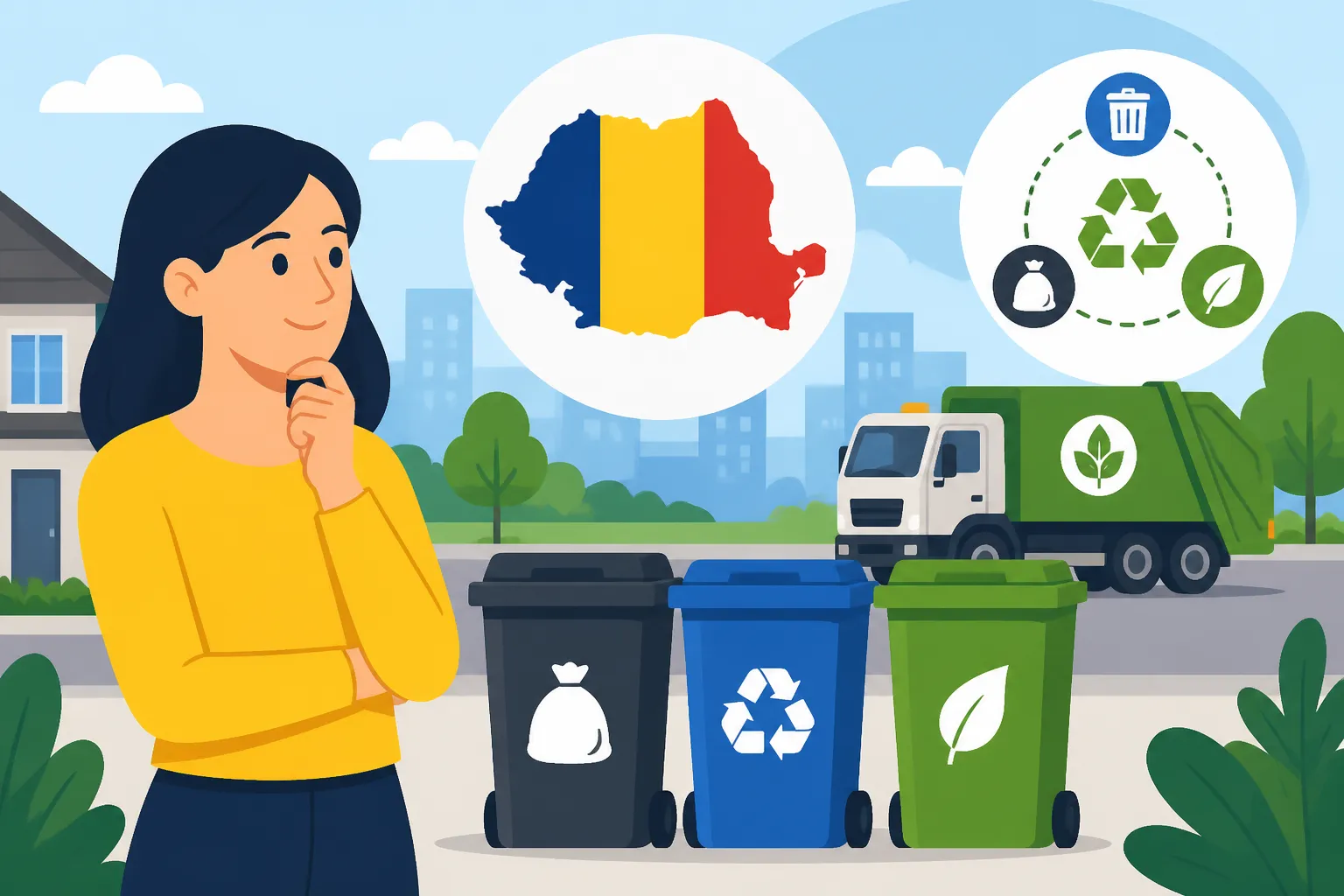
The most common system you'll encounter for residential recycling involves color-coded bins, usually provided by your waste management company. These are often large, communal bins for apartment blocks or smaller individual ones for houses. The standard colors and their corresponding waste types are:
- Yellow Bin (or Bag): For plastic packaging (PET bottles, yogurt pots, plastic bags) and metal (cans, aluminum foil). Make sure to rinse containers and flatten them to save space.
- Blue Bin (or Bag): For paper and cardboard (newspapers, magazines, cardboard boxes). Ensure they are clean and dry.
- Green Bin (or Bag): For glass packaging (bottles, jars). Again, rinse them out.
You'll also typically have a separate Black/Grey Bin for general, non-recyclable household waste (often referred to as deșeuri menajere reziduale or gunoi menajer).
It's important to remember that not all plastics are recyclable, and things like contaminated paper (pizza boxes with grease stains) or broken ceramics usually go into general waste. My biggest tip here is: if in doubt, throw it out into the general waste bin. It's better than contaminating an entire batch of recyclables. The system is improving, but still somewhat sensitive to contamination.
Locating Public Recycling Points and Collection Centers
Beyond your doorstep collection, Romania also has various public recycling points and specialized collection centers.
- Public Recycling Islands: In many cities and towns, you'll find large, often caged, containers for plastic/metal, paper, and glass in public spaces, usually near residential areas or supermarkets. These are great for when your household bins are full or if your building doesn't have direct collection.
- Supermarket Return Points: Several large supermarket chains, such as Kaufland, Lidl, and Carrefour, have invested in reverse vending machines. Here, you can return PET plastic bottles, glass bottles, and aluminum cans, often receiving a small voucher in return (the Sistem Garanție-Returnare). This is a fantastic initiative and definitely one to use!
- Dedicated Collection Centers (Centre de Colectare): For larger items, electronics, batteries, and sometimes even textiles, cities often have dedicated collection centers. These are typically municipal facilities that accept a wider range of special waste. A quick search on your local primărie's website or even a local Facebook group (if you're using a local SIM card like those from Airalo to stay connected) can point you in the right direction. For general tech needs, checking How to Choose a Mobile and Internet Provider in Romania can also help ensure you have the connectivity to find these locations.
Handling Special Waste: Electronics, Batteries, Textiles
Disposing of special waste improperly can be harmful to the environment and even illegal. Here's how to handle some common categories:
- Waste Electrical and Electronic Equipment (WEEE): For old phones, laptops, refrigerators, or toasters, many electronics retailers in Romania offer take-back schemes. If you buy a new appliance, they are usually obliged to take your old one for recycling. Otherwise, look for dedicated WEEE collection points in your city or wait for municipal collection campaigns.
- Batteries: Used batteries (AA, AAA, etc.) should never go into regular waste. You'll find small collection boxes for batteries in most supermarkets, hypermarkets, and electronics stores.
- Textiles: While not as prevalent as WEEE or battery collection, some cities have dedicated textile collection bins, often managed by charities or specialized recycling companies. In Bucharest, for instance, you can find various bins for clothes. Check local municipality websites for locations.
- Bulky Waste: For old furniture, mattresses, or construction debris, you cannot just leave them on the street. You'll either need to arrange a special collection with your waste management company (which might incur an extra fee) or transport them to a municipal bulky waste collection center. If you're undertaking a big move or renovation, companies like Sirelo might offer advice or services related to disposing of large items, so it's worth checking with them.
Tips, Tricks, and Common Expat Hurdles
Navigating waste management in Romania, like many administrative tasks, can feel like you're trying to solve a puzzle with missing pieces. But don't despair; many have walked this path before you!
Language Barriers and Bureaucracy
This is probably the biggest hurdle for new arrivals. The official documents for waste contracts or recycling guidelines are almost exclusively in Romanian. Talking to customer service at a waste management company or even asking questions at the primărie can be challenging without Romanian language skills.
- Bring a Romanian Speaker: If you have a local friend, colleague, or even your landlord, ask for their help when making calls or visiting offices. This will save you a lot of time and frustration.
- Use Translation Apps: Google Translate or similar apps are invaluable for understanding written information or for basic communication. Just be patient, as nuances can get lost.
- Patience is a Virtue: Things might not happen as quickly as you're used to. Be prepared for multiple visits, calls, or emails. This is part of the Romanian administrative experience. This is true for many official processes, including The Complete Guide to Romanian Residence Permits for Expats (2027).
Staying Informed About Local Changes
Waste management rules, schedules, and recycling practices can evolve. What was true last year might not be true today.
- Primărie Websites: Your local primărie's website (e.g., Primăria Municipiului București or Primăria Cluj-Napoca) is often the best source for official information regarding waste collection schedules, public recycling points, and special collection campaigns.
- Local Expat/Community Groups: Join Facebook groups or other online forums for expats in your city or neighborhood. People often share updates, tips, and answer questions about local services.
- Ask Your Neighbors: Once you've settled in, your Romanian neighbors are an invaluable source of hyper-local information. They know the ins and outs of their specific area's system.
- Check Utility Bills: Your waste collection bill (often integrated with other utility bills, as discussed in How Do I Pay My Utility Bills (Facturi) in Romania?) might sometimes include notices or updates about services.
Environmental Considerations and Best Practices
While getting the basics right is your first priority, remember that responsible waste management is a key part of living sustainably in your new home.
- Reduce First: The best waste is the one you don't generate. Try to reduce packaging, use reusable bags, and opt for products with less plastic.
- Composting: If you have a garden, consider composting organic waste. This isn't usually provided by municipal services but can significantly reduce your general waste.
- Educate Yourself and Others: Learn the local recycling rules thoroughly. If you see others struggling, politely share what you've learned. The more people who recycle correctly, the better the overall system will function.
It’s a journey, not a sprint, when it comes to fully integrating into the waste management system here. But with a bit of research, a dash of patience, and perhaps a helpful Romanian friend, you’ll be a pro in no time.
Disclaimer
The information provided in this guide is for general informational purposes only and does not constitute legal or professional advice. Waste management regulations and procedures in Romania can vary significantly by municipality and may change over time. While we strive to keep the information up-to-date, it is essential to verify current requirements with your local authorities or a professional advisor. We are not responsible for any inaccuracies or omissions, or for any actions taken based on the information presented herein.