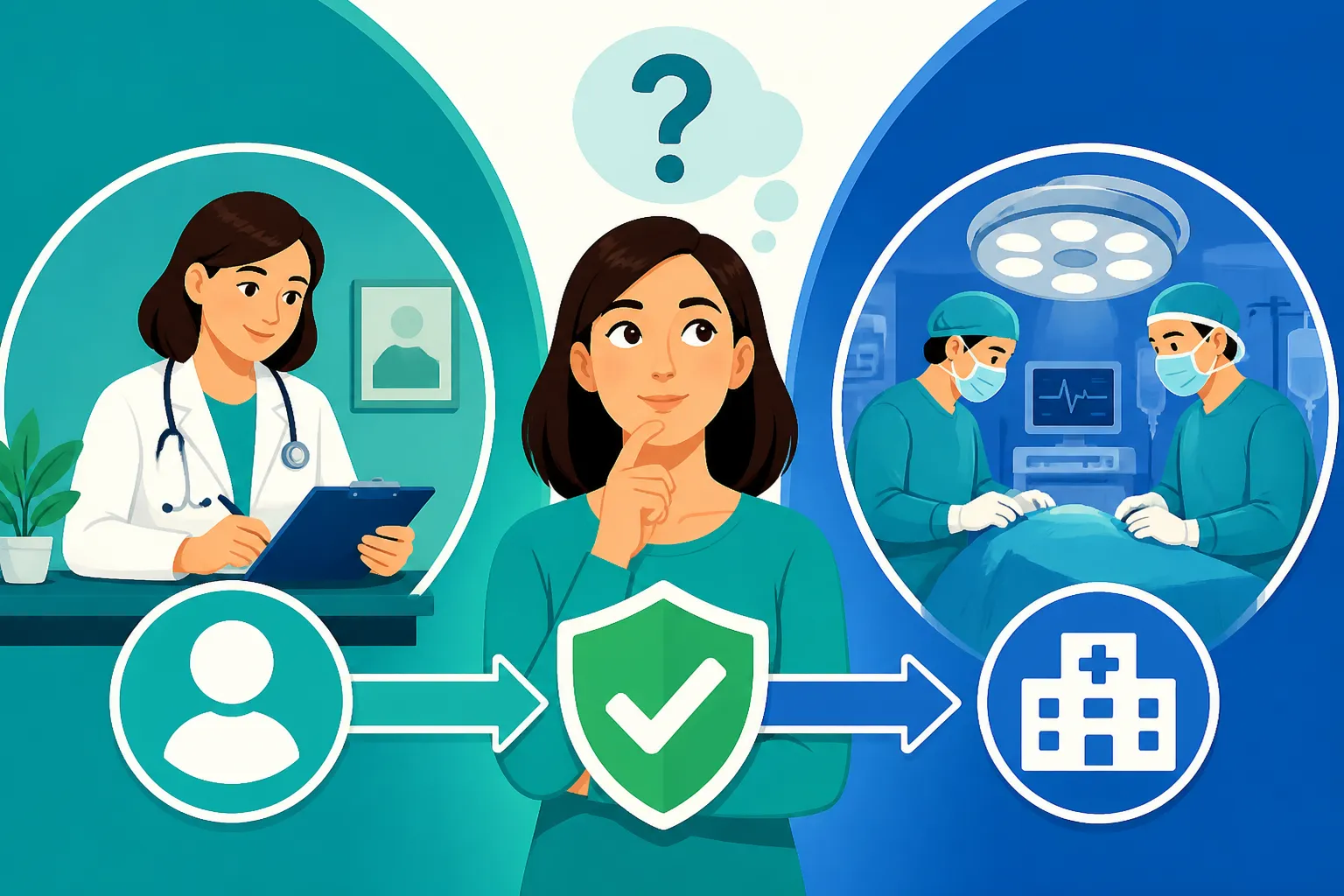
Can I See a Specialist Privately and Still Use CNAS for Surgery?
One of the most common frustrations for foreigners in Romania is facing a sudden medical issue only to find out the public waitlist for a specialist is months long, while private surgery costs a small fortune. This guide solves the dilemma of whether you can bypass the queues by seeing a private specialist and then "flipping" back to the public system (CNAS) to have your surgery covered.
The Hybrid Reality: Mixing Private and Public Healthcare in Romania
If you have spent any significant amount of time in Bucharest, Cluj, or Timișoara, you already know that the healthcare landscape is split into two distinct worlds. On one side, you have the sleek, modern private clinics like Regina Maria or MedLife, where the coffee is good and the appointments are on time. On the other side, there is the public system, managed by the National Health Insurance House (CNAS), which can feel bureaucratic and weathered but remains the backbone of major surgical procedures in the country.
The short answer to your question is: yes, you can see a specialist privately and still have your surgery covered by the public system. However, it is not a direct "plug-and-play" process. You cannot simply walk into a public hospital with a private receipt and expect a free bed. There is a specific administrative dance you must perform to ensure that your mandatory contributions, known as CASS, are actually utilized for your hospital stay. Understanding How Romania's Health Insurance House (CNAS) Works: A Full Overview is the first step in realizing that your rights as an insured person follow you, regardless of where your initial diagnosis happened.
The Legal Framework of Being an Insured Patient
As an expat, if you are employed, a PFA, or paying voluntary contributions, you are an "asigurat" (insured person). This status gives you the right to a package of basic medical services. The law does not mandate that the entire "patient journey" must happen within the public system. It only dictates that for the state to pay for a service, like a cholecystectomy or a hernia repair, the service must be performed in a facility that has a contract with the CNAS and must be triggered by a valid referral.
Many expats worry that by going "private" for the initial consultation, they have somehow opted out of their public rights. This is a myth. You pay into the public system every month through your taxes, and those rights remain valid. If you are currently in the process of moving and haven't secured your local insurance yet, you might be relying on international providers like SafetyWing to cover emergencies, but once you are in the Romanian system, the rules of CNAS take over for elective and scheduled surgeries.
The Power of the Referral System (Bilet de Trimitere)
The "Bilet de Trimitere" is the golden ticket of Romanian healthcare. It is the document that tells the public hospital that the state is picking up the tab. Most private specialists you see in a fancy clinic also hold positions in public hospitals. This is a common practice in Romania. However, a "private" consultation often results in a private recommendation or a medical report, which the public hospital’s accounting department cannot process on its own.
To successfully use the public system for surgery after a private visit, you usually need a referral that is integrated into the national electronic system. If your private specialist also works in the public sector and their private clinic has a contract with CNAS for certain services, they might be able to issue this directly. If they cannot, you will need to bring their medical report to your local GP. This is why The Expat Guide to Finding a Family Doctor (Medic de Familie) in Romania is so critical; your GP is the one who "translates" your private diagnosis into a public referral.
How to Navigate the Private Specialist to Public Hospital Pipeline
The transition from a private consultation to a public operating table is a path well-trodden by locals, but for a foreigner, the lack of transparency can be daunting. I remember the first time I needed a minor procedure; I was told the private cost was €2,000, but I could get it "free" if I waited three weeks and went to the public municipal hospital. The catch was the paperwork.
Starting with the Private Consultation
Most expats choose to start with a private consultation because of the speed of access. You can usually book a specialist within 48 hours. During this visit, you are paying for the doctor’s expertise and the diagnostic equipment. If the specialist determines that surgery is necessary, they will provide you with a medical report (referat medical) or a letter (scrisoare medicală).
It is vital to ask the doctor during this visit: "Do you also operate in a public hospital?" Many of the top surgeons in the country spend their mornings in a public "Spital" and their afternoons in a private "Clinică." If they do, they can often facilitate your admission to their public ward. This is a perfectly legal way to ensure you are treated by a doctor you trust while Navigating the Romanian Healthcare System: An Expat's Roadmap (2027) without draining your savings.
The Role of the Family Doctor in the Transition
If your specialist cannot issue a CNAS-compliant referral from their private practice, your next stop is your Medic de Familie. You will present the private specialist’s medical report to them. Under Romanian medical protocols, the family doctor can then issue a public referral (Bilet de Trimitere) for "Hospitalization" (Internare).
This step can be a point of friction. Some family doctors are hesitant to issue referrals based on private notes without doing their own basic check, but generally, if the report is from a recognized specialist, they will comply. This referral is what allows the public hospital to claim the "DRG" (Diagnosis-Related Group) payment from the state for your surgery. Without it, the hospital may try to charge you as a "self-paying" patient, even if you have a CNP and pay your taxes.
Choosing and Entering the Public Hospital
Once you have your referral, you have a degree of choice. You aren't strictly tethered to the hospital where your doctor works, although it is highly recommended to follow the surgeon who diagnosed you. When you show up at the public hospital for your scheduled surgery, you will need to bring your ID (Passport and Residence Permit), your proof of insurance (which the hospital usually checks online in the SIUI system), and your referral.
It is worth noting that for those who are still waiting for their residency permits or are in a transitional phase, having a secondary plan is wise. While you are waiting for your CNP, you won't exist in the SIUI database. In these gaps, a policy from SafetyWing can provide a safety net for urgent issues, but for scheduled surgery through the public system, the CNP is non-negotiable. You can learn more about this in our guide on How to Get Your CNP (Personal Numeric Code) for Healthcare Access in Romania.
Financial Implications and Practical Challenges
While the surgery itself might be "free" under the CNAS umbrella, "free" in the Romanian public system has a different definition than in Western Europe or North America. You are covered for the medical act, the anesthesia, the standard medications used during the stay, and the hospital bed. However, the reality on the ground often involves secondary costs that you must be prepared for.
What CNAS Actually Covers vs. Out-of-Pocket Costs
The public system is often underfunded, which leads to a "BYO" (Bring Your Own) culture in some smaller or older hospitals. While major university hospitals in Bucharest or Cluj are better equipped, it is not uncommon for patients to be asked to buy their own specialized surgical supplies if they want a specific high-end brand, or even basic items like certain painkillers or bandages if the hospital pharmacy is out of stock.
| Feature | Public Surgery (CNAS) | Private Surgery (Self-Pay/Insurance) |
|---|---|---|
| Cost of Surgeon/Anesthesia | Covered by CASS | €1,000 – €5,000+ |
| Hospital Stay (Room) | Shared (3-6 people), basic | Private or semi-private, modern |
| Wait Time | Weeks to months | Days |
| Administrative Prep | High (Referrals, CNP, SIUI) | Low (Passport/Insurance Card) |
| Post-Op Care | Basic nursing | High-touch nursing care |
If you are concerned about these gaps, you might want to look into Understanding Private Health Insurance and Subscriptions (Abonament) in Romania. Often, a private subscription covers the "specialist" part of the query, while the public system handles the "heavy lifting" of the surgery.
The "Informal Payments" Elephant in the Room
We have to talk about it: the "plic" (the envelope). Historically, Romania had a significant culture of informal payments to doctors and nurses. In 2026, the government has made massive strides in cracking down on this, and doctors' salaries in the public sector have been significantly increased to discourage the practice. Most young, modern doctors will be offended if you offer them money.
However, in some regions or with the "old guard," the expectation might still linger. As an expat, my advice is to avoid this entirely. It is technically illegal for both the giver and the receiver. If you want to show gratitude, a box of chocolates or coffee for the nursing station after you are discharged is the culturally accepted, non-problematic way to go. Focus on having your Registering for Public Health Insurance (CASS) in Romania (2027) documents in order so that you are legally beyond reproach.
The Quality of Care and Comfort
There is no sugar-coating it: a public hospital ward is not a hotel. You will likely be in a room with several other people. The food will be functional but uninspiring (mostly soups and bread). The nurses are often overworked and may not speak much English. If you are someone who requires a high level of comfort and privacy to heal, you may find the public system challenging.
Conversely, the medical expertise in public hospitals is often superior for complex cases. Because the public hospitals see the highest volume of trauma and complicated pathologies, the surgeons there are incredibly experienced. This is the trade-off: you sacrifice the "customer service" experience for high-level clinical experience and zero (or very low) financial cost. For many, this makes Public vs Private Healthcare in Romania: Which Should Expats Choose? a question of "where" the specific procedure should happen rather than choosing one system exclusively.
Necessary Documentation for a Seamless Transition
To avoid being turned away on the morning of your surgery, you need to be an administrative ninja. The public system thrives on folders (dosare) and stamps. Even if you have seen the specialist privately, the public hospital is a separate legal entity and will require its own set of paperwork.
The Checklist for Admission
Before you head to the hospital, ensure you have organized the following in a physical folder:
- Identity Document: Your original passport and your Romanian residence permit (Permis de Ședere).
- Proof of Insurance: Usually, a printed "Adeverință de Asigurat" from the CNAS website or a certificate from your employer.
- The Bilet de Trimitere: The referral from your family doctor or a CNAS-contracted specialist. This must be within its validity period (usually 30-90 days depending on the type).
- Medical History: All your scans (MRI/CT) on a CD and the written reports from your private specialist.
- Standard Tests: Public hospitals often require a set of blood tests and an EKG before admission. If you did these privately, ensure they are not older than 7-14 days.
If you are an EU citizen and haven't fully moved your insurance yet, make sure you understand How to Use Your EHIC (Cardul European) in Romania as an EU Citizen, as this can sometimes cover "planned" care if you have the S2 form, though the specialist-to-surgery route usually relies on local CASS.
Dealing with Language Barriers
One of the biggest hurdles in the public system is the language. While the specialist you saw privately almost certainly speaks fluent English, the ward nurses, the porters, and the administrative staff at the public hospital likely will not. This can lead to significant stress during the "internare" (admission) process.
If your Romanian isn't up to par, I highly recommend bringing a Romanian-speaking friend or hiring a medical translator for the first few hours of your admission. Being able to explain your allergies or understand the fasting instructions is critical. This is a recurring theme in Navigating the Romanian Healthcare System: An Expat's Roadmap (2027), where cultural and linguistic preparation is just as important as the medical diagnosis itself.
Post-Operative Follow-up: Back to Private?
Once the surgery is done and you are discharged, the "hybrid" journey can continue. You will receive a "Bilet de Ieșire din Spital" (Discharge Summary). You can take this back to your private specialist for your follow-up appointments. This is actually a very efficient way to recover. You get the expensive surgery done for free in the public system, and then you pay for the comfort of a private clinic for the stitch removal and recovery monitoring.
This approach allows you to keep a high level of continuity of care with the doctor you chose, without the prohibitive cost of private hospitalisation. Just ensure your Health Insurance in Romania: Mandatory, Private and Travel Options Explained setup covers these follow-up consultations. If you are using a provider like SafetyWing, check if your specific plan covers post-operative complications or follow-ups if the original issue was an emergency.
Understanding the Romanian Healthcare System: A Disclaimer
The information provided in this guide is for educational and informational purposes only. While we strive to provide the most accurate and up-to-date details regarding the Romanian healthcare system, medical laws and CNAS regulations are subject to frequent changes. This guide does not constitute legal or professional medical advice. Always consult with a qualified medical professional or a legal expert specializing in Romanian healthcare law before making decisions about your surgical care. The author and publisher are not responsible for any administrative delays, medical outcomes, or financial discrepancies that may arise from following the procedures outlined in this article.
Conclusion
Mixing private specialist care with public surgery is a smart, strategic way to navigate life in Romania. It allows you to skip the diagnostic queues while still benefiting from the socialized system you contribute to every month. By securing a bilet de trimitere and maintaining a good relationship with your medic de familie, you can ensure that the "big bill" of surgery is handled by the state, leaving you to focus on a speedy recovery in the comfort of your chosen post-op environment.